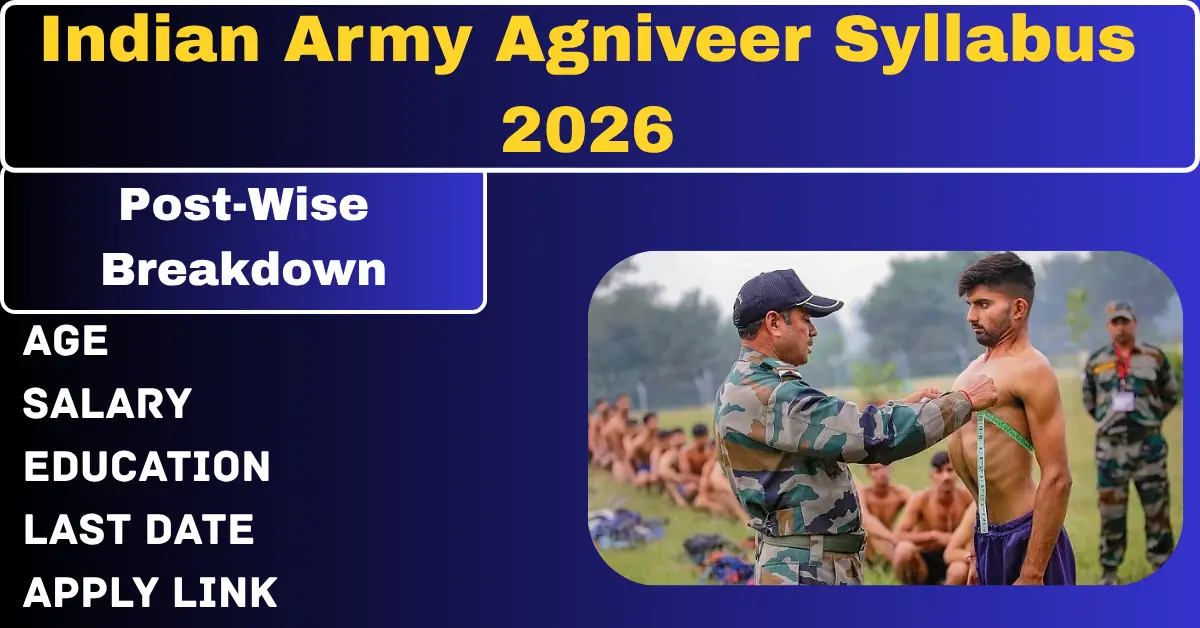
Indian Army Agniveer syllabus 2026 with post-wise marking scheme — GD, Technical, Clerk, Tradesman exam pattern, subject topics and honest prep advice.
You’ve probably already seen Agniveer syllabus pages that list subjects and call it done. Here’s what those pages skip: the marks structure is completely different depending on your post. General Duty candidates are writing a 100-mark paper. Technical and Clerk candidates are writing a 200-mark paper. Same 50 questions — but very different weightage per question, very different negative marking, and a very different strategy needed.
If you’ve been preparing without knowing this, stop right now and read this fully.
Quick Overview Indian Army Agniveer syllabus 2026
| Detail | Information |
|---|---|
| Exam Conducting Body | Indian Army |
| Exam Frequency | Once a year |
| Posts | GD, Technical, Clerk/SKT, Tradesman, GD Women MP |
| Exam Mode | Phase 1: Online CBT / Phase 2: Physical Fitness Test |
| Questions | 50 (all posts) |
| Duration | 60 minutes |
| Paper Language | English and Hindi |
| Official Website | joinindianarmy.nic.in |
The Marks Structure Nobody Explains Clearly
So here’s the thing — all posts have 50 questions, but the total marks and negative marking are not the same. This is where most “complete syllabus” guides quietly fail you.
General Duty and Tradesman: 50 questions, 100 marks total — each question carries 2 marks. Negative marking is 0.50 marks per wrong answer.
Technical and Clerk/SKT: 50 questions, 200 marks total — questions carry 4 marks each. Negative marking is 1 full mark per wrong answer.
The implication is real. In the Technical exam, one wrong answer costs you 1 mark — that’s the equivalent of one full wrong answer in a standard paper. Blind guessing is genuinely dangerous here. In GD, the penalty is lighter, but that doesn’t mean guess freely either.
Post-Wise Exam Pattern — Indian Army Agniveer Syllabus 2026 With Actual Marks
Army GD (General Duty) and Tradesman
| Subject | Questions | Marks | Negative Marking |
|---|---|---|---|
| General Knowledge | 15 | 30 | 0.50 per wrong answer |
| General Science | 15 | 30 | |
| Mathematics | 15 | 30 | |
| Logical Reasoning | 05 | 10 | |
| Total | 50 | 100 | |
| Duration | 60 minutes |
Honestly, the Reasoning section here is just 5 questions. Five. Don’t over-invest there — spend that preparation time on GK and Science instead, where 30 marks each are on the table.
Army Technical
| Subject | Questions | Marks | Negative Marking |
|---|---|---|---|
| General Knowledge | 10 | 40 | 1 mark per wrong answer |
| Physics | 15 | 60 | |
| Mathematics | 15 | 60 | |
| Chemistry | 10 | 40 | |
| Total | 50 | 200 | |
| Duration | 60 minutes |
Physics and Maths together are 120 out of 200 marks. If your Class 12 Science base is strong, this paper rewards you heavily. If it’s not — be honest with yourself about whether Technical is the right entry for you.
Army Clerk / Storekeeper Technical (SKT)
| Subject | Questions | Marks | Negative Marking |
|---|---|---|---|
| General Knowledge | 05 | 20 | 1 mark per wrong answer |
| General Science | 05 | 20 | |
| Mathematics | 10 | 40 | |
| Computer Science | 05 | 20 | |
| General English | 25 | 100 | |
| Total | 50 | 200 | |
| Duration | 60 minutes |
Watch out: English alone is 25 questions worth 100 marks — that’s half the paper. If your English is genuinely weak, Clerk is not the “easy option” it appears to be. Candidates who think they’ll scrape through Clerk without serious English preparation get a rude surprise.
Subject-Wise Syllabus For Indian Army Agniveer Syllabus 2026 — What’s Actually Inside Each Section
General Knowledge — Bigger Than It Looks
Abbreviations (national and international), sports awards, history (important dates, battles, Indian national movement), geography (solar system, peaks, rivers, lakes, Indian states and capitals), terminology (geographical, economic, astronomical, legal), countries and currencies, current events, financial and banking news, Indian Constitution, important days, UNO, Indian Armed Forces, international organisations, inventions and discoveries, books and authors, religious communities and principal languages, environment, world of plants and animals, “Who’s Who.”
Now, this list is long. Don’t panic. Army Agniveer GK has a consistent pattern across years — Indian defence history, Constitution basics, geography (especially rivers and states), and current affairs linked to national events appear almost every time. International GK appears but is secondary. Build your India knowledge first.
Pro Tip: The “Indian Armed Forces” topic is specific to Army exams — you won’t find it in Bank or SSC preparation material. Learn basic structure of the Army, key military operations India has participated in, and major defence installations. Three to four questions often come from this area alone.
General Science — For GD and Clerk Posts
Human body and its important organs, food and nutrition, diseases and prevention, vitamins and their uses, medical terms, scientific terms, scientific and research institutes in India. Plus fundamentals of Physics, Chemistry, and Biology based on day-to-day activity.
For GD candidates — this is Class 9-10 level, applied. Questions like “which vitamin prevents night blindness” or “what causes dengue” are the norm here, not derivations or formulas. If you studied your Class 10 Science conceptually rather than by rote, you’re already ahead.
Physics — Technical Post Only
Motion, force and energy, matter, gravitation, work and energy, light, heat, electricity, magnetism, sound, wave motion, domestic electric circuits, sun as energy source, fuels, heat engines, nuclear energy.
Look — this is Class 11-12 Physics territory. The topics aren’t obscure; they’re the same chapters you’ve seen before. But at 60 marks out of 200, this is the section that separates Technical candidates who actually clear the cutoff from those who don’t. Go back to NCERT Class 11 and 12 Physics. Not coaching notes — the actual NCERT. The language and concept framing in Army Technical papers aligns closely with NCERT.
Chemistry — Technical Post Only
Matter and its nature, electrochemical cells, classification of elements (Periodic Table basics), carbon and its compounds, extraction of metals, chemical bonding, electrolysis, natural resources — water and air.
Ten questions, 40 marks. A well-prepared candidate should get 7-8 right here. Carbon compounds and periodic table classification appear consistently. Electrochemical cells and electrolysis are slightly less predictable but worth knowing.
Mathematics — All Posts, Different Depth
For GD: Natural numbers, decimal fractions, HCF and LCM, square roots, ratio and proportion, percentage, average, profit and loss, time-work-distance, simple interest, basic algebra, quadratic equations, geometry (lines, angles, triangles, circles), mensuration (area and volume of standard shapes).
For Clerk: Everything above, plus logarithms, surds and indices, statistics (mean, median, mode, frequency polygons, histograms), trigonometry (heights and distances), and solution of linear equations with two and three variables.
For Technical: All of the above plus calculus, probability, computing basics, and statistics at a higher level.
Here’s my honest take: Maths is where consistent daily practice pays off more than any other subject. Even 20-30 questions daily for six weeks builds speed and accuracy that you simply can’t get from reading theory. Get a previous-year Agniveer paper and time yourself — if you’re taking more than 70 seconds per Maths question, your speed needs work.
Computer Science — Clerk/SKT Only
This is one of the most detailed sections in the Clerk syllabus, and it surprises candidates who assume it’ll be basic.
Computer basics: CPU, VDU, keyboard, concept of memory (RAM, ROM), units of memory (Byte through Terabyte), input/output devices including mouse, scanner, OCR, MICR, printer, plotter, digital camera.
MS-Windows: Operating system basics, file and folder management, Windows Explorer, system date and time, basic accessories (Notepad, Paint, Calculator, WordPad).
MS-Word: Creating, saving, editing, formatting documents — text styles, headers and footers, page numbering, spell check, tables, WordArt, bullets and borders.
MS-Excel: Worksheets and workbooks, entering data, AutoFill, formatting cells, rows and columns.
MS-PowerPoint: Slide layouts, creating presentations, Normal view, Slide Sorter, Slide Show, editing slides.
So, this is not just “what is a computer” level anymore. If you haven’t actually used MS Office practically — open it and start working in it. Reading about MS-Word features doesn’t prepare you for questions on specific menu options and functions.
General English — Clerk/SKT Only (And It’s Half the Paper)
Parts of speech, articles, nouns, pronouns, adjectives, prepositions, conjunctions, modals, verbs, tenses (present/past/future, simple/continuous/perfect forms), sentence structures, types of sentences (affirmative and interrogative), direct and indirect speech, idioms and phrases, synonyms and antonyms, one-word substitution.
25 questions, 100 marks. Half your paper. If I were preparing for Clerk, I’d spend at least 40% of my total study time on English — grammar rules first, then vocabulary, then comprehension practice. Most candidates do the opposite and wonder why their score isn’t moving.
Logical Reasoning — GD and Tradesman
Number ranking and time sequence, coding-decoding, direction sense, logical sequence of words, analogy, clocks and calendars, statement-conclusions, Venn diagrams, alpha-numeric puzzles, data sufficiency, situational reaction tests, arithmetic reasoning.
Only 5 questions in GD — but those 10 marks can be the difference at the borderline. Coding-decoding and direction sense are the most frequently tested. The Situational Reaction Test (SRT) is unique to Army exams: you’re given a scenario and asked what you’d do. There’s no formula — answers test whether your instinct aligns with discipline, initiative, and common sense. Practice with Army-specific SRT question banks, not generic reasoning books.
Physical Test — What Most Guides Don’t Say Loudly Enough
The written exam is Phase 1. Physical Fitness Test is Phase 2. Both are eliminatory.
Here’s what happens in reality: candidates spend three months on syllabus preparation and two weeks “getting fit.” That doesn’t work. The 1.6 km run, pull-ups, balance beam, and 9-foot ditch jump require genuine cardiovascular and muscular conditioning — and that takes 10-12 weeks minimum to build from a base level.
Start physical training the day you start written preparation. Not after results. Not after admit card. Today.
A Realistic Preparation Timeline
Month 1: NCERT Class 9-10 Science and Maths (GD/Tradesman). Class 11-12 Physics, Chemistry, and Maths for Technical. Start daily 20-minute current affairs habit.
Month 2: Subject-specific question practice. Use previous year Agniveer papers — not SSC or Railway papers, the question style is different. For Clerk, start MS Office practical sessions alongside theory.
Month 3: Full timed mock tests on screen. Identify your bottom two subjects and give them extra daily time. Revise GK topics that keep slipping.
Throughout all three months: physical conditioning, every single day.
Who Should Seriously Consider Agniveer Right Now?
If you’re between 17.5 and 23, have the relevant qualification, and want a structured start in life — this is worth your full effort. The 4-year tenure gets debated a lot online. Let me be direct: for many candidates from smaller towns who don’t have another clear path, the training, the salary, the discipline, and the priority in subsequent government recruitment afterwards is a genuinely useful foundation. Go in knowing what the commitment is, and prepare accordingly.
If you’re already close to the age limit and simultaneously preparing for MPSC, Police, or SSC — don’t drop everything for Agniveer. But if you’re 18-20 and haven’t locked into anything yet, this deserves serious attention.
Frequently Asked Questions
Q1. What is the negative marking in Agniveer exam — is it the same for all posts? No, it differs significantly. For GD and Tradesman, 0.50 marks are deducted per wrong answer (out of a 100-mark paper). For Technical and Clerk/SKT, 1 full mark is deducted per wrong answer (out of a 200-mark paper). The penalty is proportionally the same, but psychologically and strategically the higher-mark papers require more caution before guessing.
Q2. The Clerk exam has 25 English questions — how hard is the English actually? It’s grammar-heavy — tenses, parts of speech, direct-indirect speech, sentence correction — rather than vocabulary-heavy. If you studied English grammar properly in Class 10, you have the base. What trips candidates up is tense forms and direct-to-indirect conversion. Practice these specifically, not just vocabulary lists.
Q3. Is there a typing test for Clerk, and what speed is required? Yes, Clerk/SKT has a separate typing test after the written exam. The requirement is typically around 35 words per minute in English. This speed sounds manageable but takes consistent daily practice to reach — usually 6-8 weeks of 30-minute daily typing sessions. Don’t start two weeks before the exam.
Q4. For Technical entry, does the syllabus go beyond Class 12? No — but it goes fully up to Class 12 level, and the questions are application-based rather than definition-based. Calculus, probability, wave motion, electrochemistry — these are all Class 11-12 topics. The notification doesn’t list anything beyond that, but your Class 12 foundation needs to be genuinely solid, not just passed.
Q5. Can I prepare for GD and Technical at the same time? Technically yes, but practically it’s harder than it sounds. The Technical paper requires Class 12 Physics and Chemistry that GD doesn’t need. If you’re genuinely strong in Science, focus on Technical — the lower competition (fewer candidates have a strong Science base) and higher marks structure work in your favor. If Science is a weak point, GD is the better bet and deserves your full focused preparation.
Important Links
| Resource | Link |
|---|---|
| Official Agniveer Recruitment Website | joinindianarmy.nic.in |
| Agniveer Syllabus PDF Download | joinindianarmy.nic.in |