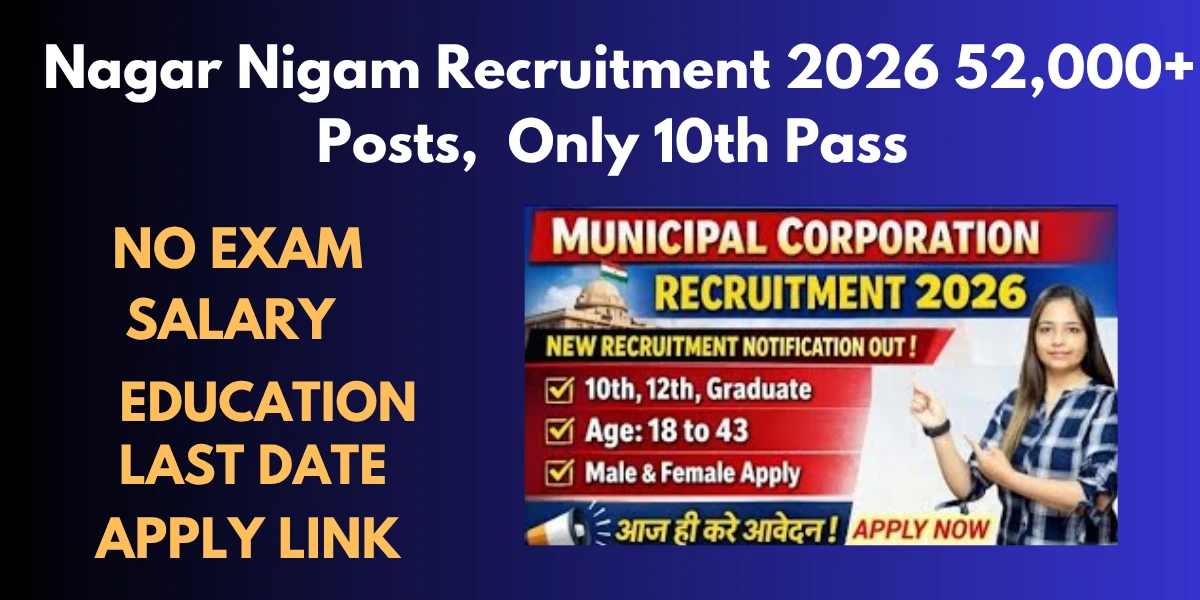
Nagar Nigam Recruitment 2026 52,000+ Posts, No Written Exam Only 10th Pass : There are very few government recruitments where someone with a Class 10 pass and no coaching background has a real shot. This is one of them. Over 52,000 posts across municipal corporations in India — and for many of these, selection is merit-based, not exam-based. That’s not nothing. But before you get excited, let me walk you through what this recruitment actually looks like on the ground, what the salary really means, and whether it makes sense for your situation specifically.
Nagar Nigam Recruitment 2026 52,000+ Posts, No Written Exam Only 10th Pass
Quick Overview
| Detail | Info |
|---|---|
| Recruiter | Nagar Nigam (Municipal Corporations) |
| Total Posts | 52,438 (Approx.) |
| Apply Mode | Online |
| Salary | ₹28,400/- (Basic) |
| Age Limit | 18 to 40 years |
| Last Date | District-wise (varies) |
| Application Fee | General/OBC: ₹100 | SC/ST: Free |
When Can You Apply — And What You Should Do on Each D
Honestly, this is where most people lose before they’ve even started.
The notification lists April/May 2026 as the application window, but — and this is important — the last date varies district to district. That’s not a typo. Nagar Nigam recruitment is decentralised. Your district’s municipal corporation may have a different portal, a different timeline, and a different set of posts than the next district over.
First, find your specific district’s Nagar Nigam official website — not a third-party job portal, the actual .gov or .nic.in site. Second, check whether your state’s urban development department has a centralised recruitment portal (UP, Maharashtra, and MP often do). Third, don’t apply on the last day. Government portals crash. Every single time. I’ve seen candidates lose out because the server went down at 11:45 PM and their form never submitted. Apply in the first five days of the window opening.
Watch out: If a site asks you to pay more than ₹100 as application fee for this recruitment, close it. That’s not the official portal.
What Qualification Do You Actually Need?
The short version: Class 10 pass gets you in the door for most posts. Class 12 with basic computer knowledge opens up the clerical-side roles. Nagar Nigam Recruitment 2026 52,000+ Posts, No Written Exam Only 10th Pass
Group D / Office Attendant / Lower-Level Posts — 10th pass is sufficient. These are the bulk of the 52,000+ vacancies. If you have your 10th marksheet and passing certificate, you’re eligible.
Clerical / Clerk-Cadre Posts — 12th pass plus basic computer knowledge is typically required. Some notifications ask for typing speed (usually 25-30 WPM in Hindi or English). If you’ve done a basic computer course — even a 3-month DCA — mention it. Keep the certificate ready.
One common mistake people make: uploading their admit card instead of their marksheet. The admit card proves you appeared for the exam. The marksheet proves you passed. They’re not the same document. Make sure you have both.
If you’re borderline — say, your 12th result is pending or your certificate is from an open board — check your specific state’s Nagar Nigam notification carefully. Open board certificates (NIOS, state open schools) are generally accepted, but confirm this before applying.
Age Limit — Who This Is Actually For
18 to 40 years is the general range. Now let’s do the actual math for reservations:
- OBC candidates: 3 years relaxation → upper limit becomes 43
- SC/ST candidates: 5 years relaxation → upper limit becomes 45
- PwD candidates: 10 years relaxation → upper limit becomes 50 (sometimes more, state-dependent)
The key phrase you need to know: age is calculated as on the last date of application, not today. So if the last date is May 31, 2026, and you turn 41 on June 15 — you’re fine. You’re still 40 on May 31.
Here’s something most guides skip: if you’ve previously worked as a government employee or in the armed forces, additional relaxations may apply. Check your state’s specific rules — they’re not uniform across India.
How They Actually Pick Candidates — And Where Most People Fail
For many posts in this recruitment, there’s no written exam. Selection is merit-based — meaning your 10th or 12th marks are what get you the job.
That sounds easier. It’s not, for one reason: everyone applies.
When there’s no exam filter, the competition shifts entirely to document verification. Candidates fail at this stage not because they’re unqualified — but because their documents don’t match. Name spelling difference between Aadhar and marksheet. Date of birth mismatch. Category certificate issued after the cutoff date. These are the real reasons people get rejected at DV stage.
Pro Tip: Before you apply, physically place every document side by side and check that your name, father’s name, and date of birth are identical across all of them. One mismatch = rejection at document verification, even if your marks are strong.
For posts where a written exam does happen, it’s generally a basic general knowledge and reasoning paper. Nothing that requires expensive coaching — but you should still give it 4-6 weeks of consistent practice.
Realistic timeline from application to joining: 6 to 18 months, depending on the state and how quickly the department moves. Some Nagar Nigam recruitments move fast. Others take two years. Don’t leave your current work for this until you have a joining letter.
The Salary — What ₹28,400 Actually Means in Your Han
Let me be straight with you. ₹28,400 is the basic pay. What hits your account every month will be different — both higher and lower depending on factors they don’t tell you upfront.
What gets added: DA (Dearness Allowance), HRA (House Rent Allowance — varies by city tier), and possibly a travel allowance. In a Tier-2 city, your gross could realistically be ₹35,000–₹40,000.
What gets deducted: PF (12% of basic), and if your gross crosses the threshold, income tax. In-hand for most Group D posts in this range is typically ₹24,000–₹30,000 after deductions.
Compared to similar roles — an SSC MTS post currently pays around ₹18,000–₹22,000 basic, so Nagar Nigam at this level is actually competitive. A private sector equivalent (office attendant, data entry) in a small city pays ₹12,000–₹18,000 with zero job security.
The real value here isn’t the salary. It’s the permanence, the pension under NPS, the medical benefits, and the fact that you’re not losing your job if the company shuts down.
Is This Job Worth Applying For? An Honest Look
This section won’t appear in any official notification. It’s just my take after watching people apply for government jobs for over a decade.
Nagar Nigam jobs are underrated. Seriously. People chase Railways and SSC and ignore municipal corporation jobs — partly because the process is less centralised and harder to track, partly because there’s less “status” attached. But here’s what I’ve noticed: Nagar Nigam employees often have better work-life balance than railway or police staff, postings are usually local (you stay in your district or nearby), and promotions — while slow — do happen.
Who should prioritise this? Anyone who is 10th or 12th pass, between 20 and 38, and wants a stable local government job without relocating. Especially if you have family responsibilities and can’t move to another city for a posting.
Who might look elsewhere? If you have graduation and are aiming for a Group B or Group C post with better pay scale, SSC CGL, State PSC, or bank PO might be a better use of your prep time. Nagar Nigam is excellent — but it’s not the ceiling for everyone.
How to Apply — Step by Step
Use a laptop or desktop, not a phone. I know everyone has a smartphone, but government portals are not optimised for mobile. Forms break, uploads fail, and you don’t want to discover that after paying the fee.
- Go to your district’s official Nagar Nigam website (search: “[your city] Nagar Nigam official website recruitment 2026”)
- Find the recruitment/bharti section — usually under “News” or “Citizen Services”
- Register with a valid mobile number and email ID you actually check
- Fill personal, educational, and category details carefully — match them exactly to your documents
- Upload photo (usually JPEG, 20–50 KB, passport size) and signature (10–30 KB)
- Pay ₹100 via UPI, net banking, or card — keep the payment receipt
- Submit and take a screenshot of the confirmation page immediately. Download the PDF. Print it if you can.
After submitting, note your application/reference number somewhere physical — a notebook, not just your phone. Phones get lost.
Documents You’ll Need
| Document | Common Mistake |
|---|---|
| Aadhar Card | Using old address — update it if you’ve moved |
| 10th Marksheet + Certificate | Uploading admit card instead of marksheet |
| 12th Marksheet (if required) | Missing the “passing certificate” — marksheet alone sometimes isn’t enough |
| Category Certificate (SC/ST/OBC) | OBC certificate issued before the current financial year — many states require a fresh one |
| Passport Photo | Using a photo more than 6 months old, or a selfie — use a studio photo |
| Signature scan | Signing in pencil or using a digital font — must be handwritten in blue/black ink |
| Income certificate (if applicable) | Issuing authority matters — must be from SDM/Tehsildar, not a gram pradhan |
If you don’t have a caste certificate yet, get it made now. It takes 15–30 days in most districts. Don’t wait until the last week.
So Should You Apply?
If you’re 10th or 12th pass, between 18 and 40, and want a government job close to home — yes, apply. The fee is just ₹100 for general candidates and zero for SC/ST. There’s no reason not to.
But apply smart. Find your specific district’s notification, not a generic national one. Make sure your documents are consistent and ready. Apply in the first week of the window. And don’t quit your current work until you have a confirmed joining date — government timelines are unpredictable.
This isn’t a recruitment you should lose sleep over. It’s one you should apply for quietly, prepare your documents carefully, and let the process move at its pace.
FAQ
Can I apply in multiple states or districts? Nagar Nigam recruitment is managed locally — each municipal corporation runs its own process. Technically you can apply in multiple districts if you meet the eligibility, but your posting will be in that specific area. If you’re not willing to work there, don’t apply there.
What happens after the apprenticeship or probation period? Most Nagar Nigam posts come with a 2-year probation. After successful completion and document verification at that stage, you’re confirmed as a permanent employee. Promotions depend on department vacancies and seniority — it’s slow but real.
Is there a physical test for any of these posts? For most clerical and Group D posts, no. But some specific posts — like certain field-based roles — may include a physical fitness test. Check your specific post’s selection criteria in the district notification.
My OBC certificate is three years old. Will it work? Probably not for most states. Many states require OBC (Non-Creamy Layer) certificates to be issued within the last financial year. Get a fresh one from your SDM’s office before applying — it’s better to have it ready than to scramble later.
If there’s no exam, how do they decide who gets selected from thousands of applicants? Merit list based on your qualifying exam marks — typically 10th or 12th percentage. Higher marks = higher chance. So if you’re still in Class 12, take it seriously. Those marks will follow you into government job applications for years.
Important Link
| Link | Details |
|---|---|
| Official Website | Your district’s Nagar Nigam / municipal corporation official site |
| Apply Online | Available on respective district portals |
| Official Notification | mpurban.gov.in |
| Check State Portal (Maharashtra) | mahaonline.gov.in |
| Check State Portal (MP) | mpurban.gov.in |
1 thought on “Nagar Nigam Recruitment 2026 52,000+ Posts, No Written Exam Only 10th Pass”