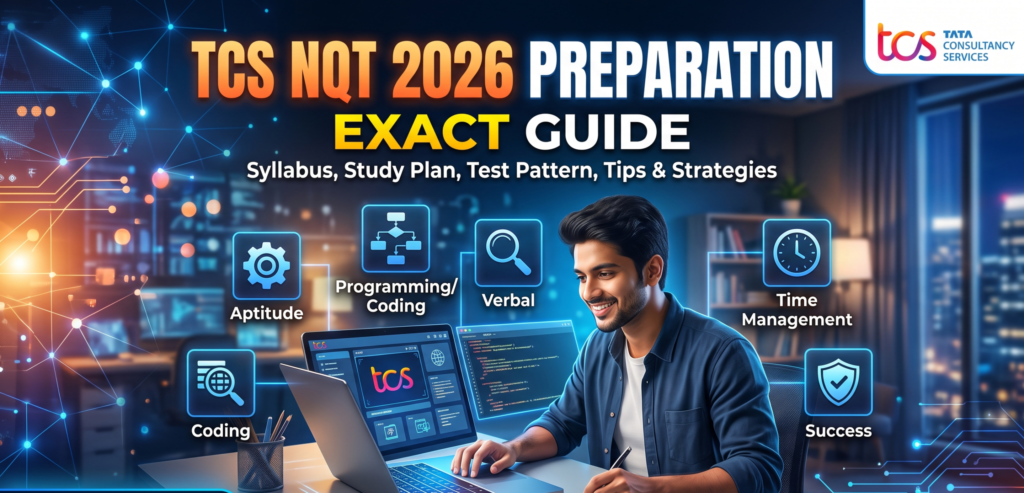
TCS NQT 2026 Preparation Exact Guide
If you are preparing for TCS NQT 2026, you do not need to watch dozens of videos or spend money on unnecessary preparation resources. You mainly need to understand the exam pattern, follow the right resources, and prepare strategically.
In this guide, we will discuss the different TCS profiles — Ninja, Digital, and Prime — along with the exam pattern, expected cut-offs, aptitude preparation, coding preparation, and useful resources.
TCS NQT 2026: How Does It Work?
TCS NQT is conducted across India, and candidates can receive different job opportunities based on their performance and score.
For 2026, the examination is expected to be open to candidates from backgrounds such as:
- B.Tech
- M.Tech
- MCA
- M.Sc
- BCA
- Other eligible courses
You should complete the registration through the official TCS NQT process and check the eligibility criteria before applying.
TCS NQT Job Profiles
TCS NQT can provide opportunities for different profiles, including:
- TCS Ninja: Around ₹3.6 LPA
- TCS Digital: Around ₹8 LPA
- TCS Prime: Around ₹9–12 LPA
The exact package and selection depend on the recruitment cycle, performance, eligibility, and other factors.
The main goal should be to perform as well as possible in the common examination rather than preparing separately for each profile.
The test consists of multiple sections - Quantitative Aptitude Logical Reasoning Verbal Ability Advanced Quantitative Aptitude and Advanced Reasoning Coding The coding section generally contains two coding questions.
The exact cut-offs can vary depending on the recruitment cycle and candidate performance. However, the general strategy can be understood through different performance levels. Ninja If you perform well in the first part of the examination and clear the required qualifying criteria, you may become eligible for the TCS Ninja profile. The package is generally around ₹3.6 LPA, subject to the applicable recruitment terms. Digital If you perform strongly in the aptitude sections and successfully solve at least one coding problem, you may become eligible for the TCS Digital profile. The package discussed for this level is around ₹8 LPA. Prime TCS Prime is considerably more competitive. Only a small percentage of candidates may reach this level, and the difficulty is significantly higher. A strong performance across the aptitude and coding sections is required. The package can be around ₹9–12 LPA, depending on the applicable offer and other factors. Therefore, the recommended approach is simpl
How to Prepare for TCS NQT 2026
1. Quantitative Aptitude
For aptitude preparation, you do not need dozens of different websites.
Focus on practicing questions from reliable aptitude platforms and previous-year-style questions.
Important topics include:
- Time and Work
- Profit and Loss
- Percentages
- Ratio and Proportion
- Averages
- Time, Speed and Distance
- Number Systems
- Simple and Compound Interest
- Permutations and Combinations
- Probability
- Other common quantitative aptitude topics
Do not spend most of your preparation time solving extremely easy questions. Try to gradually increase the difficulty level.
Recommended YouTube Resource
A useful option mentioned in the video is Smart Study, particularly for candidates who prefer learning in Hindi or bilingual Hindi-English explanations.
The channel provides explanations for various quantitative aptitude and reasoning topics and can be useful when you are struggling with a particular concept.
2. Logical Reasoning
Logical reasoning should be prepared alongside quantitative aptitude.
Focus on topics such as:
- Series
- Coding-Decoding
- Blood Relations
- Directions
- Seating Arrangement
- Puzzles
- Syllogisms
- Data Interpretation
- Logical Patterns
The important point is to understand the underlying concepts rather than simply memorizing solutions.
3. Verbal Ability
For the verbal section, practice regularly instead of trying to complete everything in one day.
Focus on:
- Reading Comprehension
- Grammar
- Vocabulary
- Sentence Correction
- Para Jumbles
- Synonyms and Antonyms
- Sentence Completion
Regular practice is more important than collecting a large number of resources.
4. Coding Preparation
Coding is one of the most important parts if you are targeting TCS Digital or Prime.
Do not rely entirely on shortcuts or tricks.
You should build a strong foundation in:
- Arrays
- Strings
- Searching
- Sorting
- Hashing
- Basic Mathematics
- Recursion
- Basic Data Structures
- Problem Solving
Previous-Year Coding Questions
A useful starting point is to practice previous-year TCS NQT coding questions.
You can begin with a set of approximately 50 previous-year or frequently discussed coding problems.
However, do not assume that the exact same questions will appear in your examination.
The purpose of solving these questions is to understand the question patterns and difficulty level.
Practice Around 250 Coding Problems
For stronger preparation, practice a larger collection of coding problems covering different difficulty levels.
A useful structure could be:
- Easy problems
- Medium problems
- Hard problems
- Searching problems
- Sorting problems
- Array problems
- String problems
- Other common interview-style problems
A collection of around 250 carefully selected problems can provide much better preparation than repeatedly solving the same few questions.
You can also use platforms such as Code for Success or other coding-practice websites to practice problems by topic and difficulty.
For example, you can select a topic such as Arrays and then solve Easy, Medium, and Hard problems systematically.
5. Do Not Waste Money on Too Many Resources
One of the biggest mistakes candidates make is collecting too many preparation resources.
You do not need:
- 10 different aptitude courses
- Multiple coding sheets covering the same problems
- Dozens of YouTube playlists
- Expensive placement packages
Instead, choose a small number of good resources and complete them properly.
For example:
Aptitude → One good platform + one reference book
Coding → Previous-year questions + structured coding sheet
Verbal → Regular practice + mock tests
The objective is not to collect resources. The objective is to complete them and become exam-ready.
6. RS Aggarwal for Aptitude
Another commonly used resource is R.S. Aggarwal’s Quantitative Aptitude book.
You can use it to practice additional aptitude questions.
However, if you have limited time, prioritize the most relevant topics instead of trying to complete the entire book.
Smart preparation is more important than simply solving a huge number of questions.
7. Coding Test Cases Are Important
When solving coding questions in the actual examination, do not assume that getting a few test cases correct means you have successfully solved the problem.
Your objective should be to write a correct and optimized solution that passes all applicable test cases.
Pay attention to:
- Input format
- Output format
- Edge cases
- Time complexity
- Space complexity
- Constraints
Always test your solution with different types of inputs before submitting it.
8. Target Prime, But Secure Your Selection
The ideal strategy is to prepare for the highest possible profile.
If your target is Prime, prepare at that level.
However, do not become so focused on Prime that you neglect the qualifying sections required for a basic selection.
Your preparation should follow this order:
Step 1: Build aptitude fundamentals.
Step 2: Strengthen logical and verbal ability.
Step 3: Practice coding consistently.
Step 4: Solve previous-year-style questions.
Step 5: Take mock tests.
Step 6: Improve your weak areas.
Step 7: Practice complete timed tests.
This approach gives you a better chance of qualifying while also keeping Digital and Prime within reach.
9. Additional Development Skills
After preparing for the TCS NQT examination, you can also focus on development skills.
If you are interested in software development, consider learning:
- Java
- Spring Boot
- REST APIs
- SQL
- Data Structures and Algorithms
- Git
- Microservices
- DevOps
For students who need projects for their college curriculum, building projects while learning Spring Boot can be particularly useful.
Instead of learning only theory, try to build projects and understand:
- How the application works
- How APIs are created
- How databases are connected
- How exceptions are handled
- How errors are debugged
- How the application is deployed
Practical project experience can help you beyond the TCS NQT examination as well.